
On the Brink of Oblivion: A Private at the Key
9/20/2026
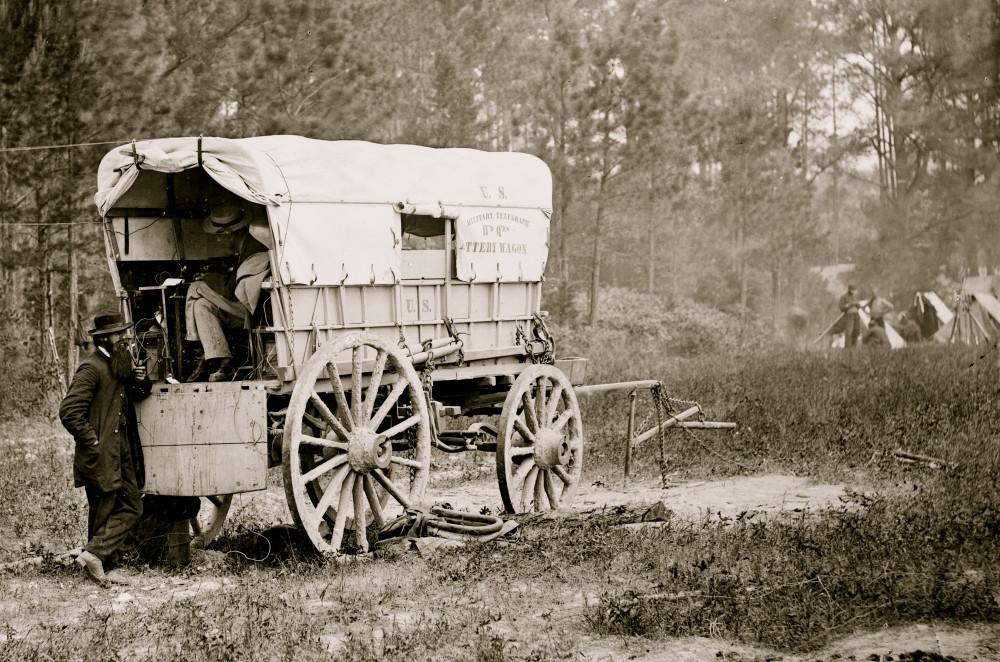
On the Brink of Oblivion
William R. Plum and the Memory of the United States Military Telegraph
USMT Profile
Name: William Rattle Plum
Born: March 24, 1845, Massillon, Ohio
Service: 1862–1865
Military status: Private, United States Army; assigned to military telegraph duty
Principal theaters: Kentucky, Tennessee, and Georgia
Positions: Telegraph operator, station manager, chief operator, cipher operator
Senior headquarters: Major General George H. Thomas
Known for: Authoring the first comprehensive history of the United States Military Telegraph
A Candle, a Cipher, and a Sixteen-Year-Old Operator
Late one night in early 1862, William R. Plum sat in a dim room in Campbellsville, Kentucky.
The building was little more than a log tavern. Its doors were bolted, and a single candle provided only enough light to expose part of the room. Plum was sixteen years old and on his way to his first military telegraph station.
With him was William G. Fuller, an experienced telegrapher who had already encountered Confederate raiders while maintaining the lines through central Kentucky.
Before Plum could be trusted with confidential government traffic, Fuller administered an improvised oath of secrecy. Plum later admitted that Fuller possessed no legal authority to administer it, but the ceremony was treated with complete seriousness.
Fuller then introduced the teenager to the mysteries of the government cipher.
The moment reads almost like an initiation. Plum entered the war not on a parade ground or beneath a regimental flag, but in a locked tavern room where one telegrapher quietly entrusted another with the means of concealing military information.
Nearly twenty years later, Plum reconstructed the scene in his two-volume history of the United States Military Telegraph. By then, the candlelit lesson had acquired a second meaning.
Fuller had taught Plum how to protect a message from the enemy.
Plum would eventually devote himself to protecting the memory of the men who sent those messages from being lost altogether.
A Private at the Key
William Rattle Plum was born in Massillon, Ohio, on March 24, 1845. He attended high school at Cuyahoga Falls and entered telegraphy while still a boy.
In 1860 and 1861, he managed the telegraph office at Atwater, Ohio. He later worked in the Cleveland headquarters of the Cleveland and Pittsburgh Railroad.
The profession required concentration, mechanical aptitude, and an ability to distinguish patterns by sound. Telegraphers learned to recognize one another through the rhythm with which they formed letters. A skilled operator could often identify the man at the other end of a circuit before a name was transmitted.
Plum therefore possessed a valuable wartime skill before he was old enough to vote.
In February 1862, according to Yale University’s record of its graduates, Plum enlisted as a private in the Union Army and was assigned to the Military Telegraph Corps. The Library of Congress identifies his surviving wartime portrait as Private William Rattle Plum of Companies D and A, 18th United States Infantry.
His status deserves attention because it differed from that of many United States Military Telegraph operators.
Most USMT employees were civilians working under the War Department, even when they lived with armies and operated inside military headquarters. Plum, however, appears in surviving institutional records as an enlisted soldier assigned to telegraph duty.
Later accounts sometimes called him “Colonel Plum,” but the securely identified wartime photograph shows him in the uniform of a private. The colonelcy was evidently a postwar or honorary form of address rather than his Civil War rank.
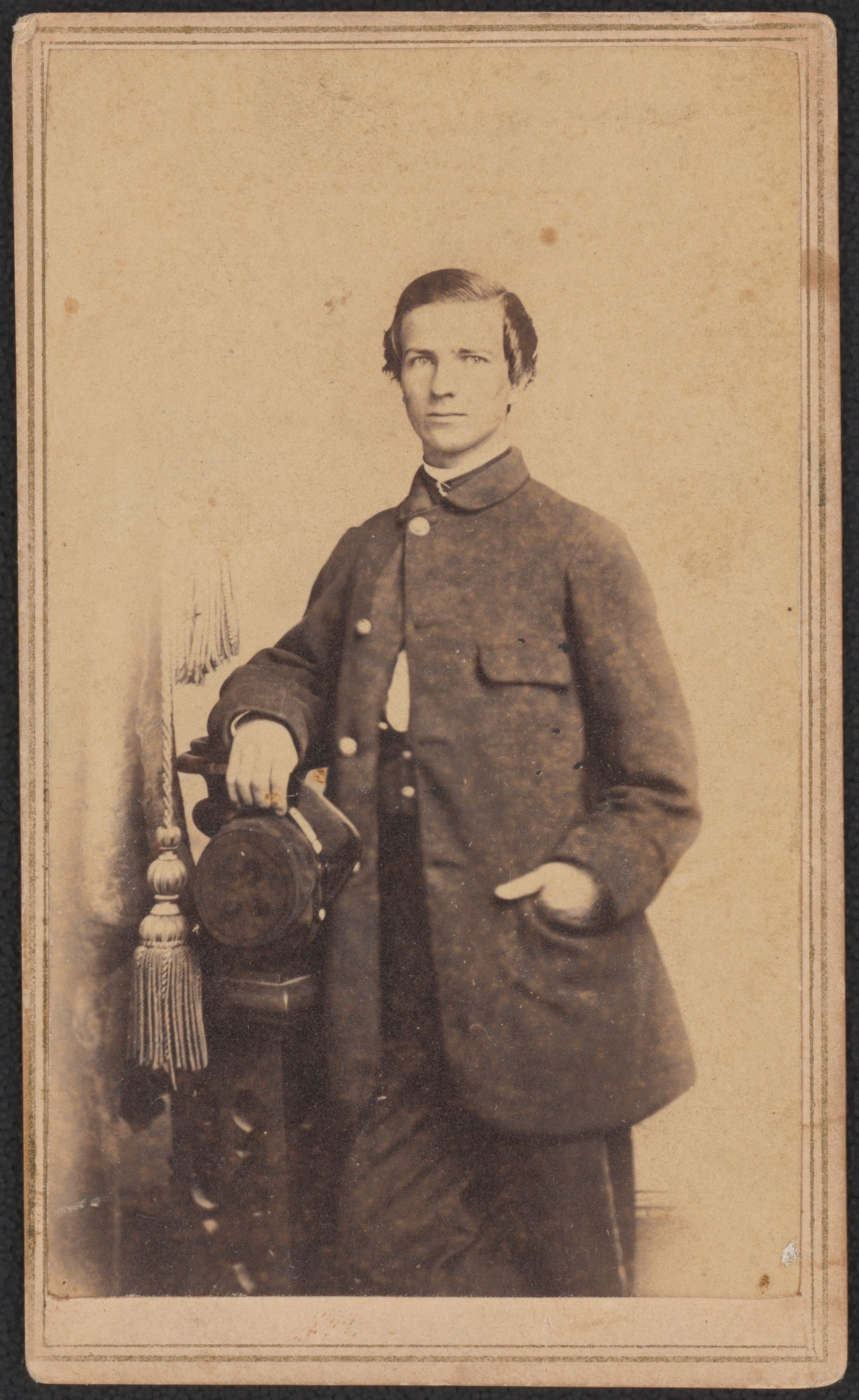
Library of Congress record: https://www.loc.gov/pictures/item/2021641019/
Plum’s enlistment did not place him in the ordinary life of an infantry private. His technical training carried him almost immediately into the military telegraph network developing across Kentucky and Tennessee.
There he became part of a service whose men rarely marched together, seldom occupied a single camp, and possessed no battlefield formation of their own.
Their unit was the wire.
Morgan on the Wire
One of Plum’s earliest experiences demonstrated how easily the telegraph itself could become a weapon.
During John Hunt Morgan’s Kentucky raid in July 1862, Confederate forces entered Lebanon and seized its telegraph office. Morgan traveled with George A. Ellsworth, an exceptionally capable Confederate telegrapher known as “Lightning” Ellsworth.
Ellsworth understood that capturing an office meant more than cutting the wire. If he could impersonate the regular operator, he could gather Union intelligence, misdirect troops, and conceal Morgan’s movements.
At the time, Plum was the day operator at Lebanon Junction. W. H. Drake worked the night shift, while D. E. Martyn normally operated the Lebanon station.
When Plum came on duty, he called Lebanon and asked about Morgan. The operator on the captured end replied that Confederate troops had attacked but had been driven away.
The answer sounded plausible.
Then the operator acknowledged another transmission with the signal “OK.”
Martyn never used it.
That small departure from habit made Plum suspicious. It was not enough to prove that Lebanon had fallen, and another operator initially dismissed the concern because he believed he had been speaking with Martyn for hours. Yet Plum had noticed something that could not be found in the words alone.
The man on the wire did not sound like Martyn.
Telegraphic identity rested partly upon rhythm, spacing, vocabulary, and habit. An intruder could possess the instrument, copy the call signs, and read messages left in the office, but perfectly imitating another operator was much harder.
Ellsworth’s use of the captured wires during Morgan’s raids became one of the most famous examples of Civil War telegraphic deception. For Plum, it was also an early lesson in the human character of communications security.
A circuit was only as secure as the people operating it—and sometimes a single unfamiliar acknowledgment could expose an enemy at the key.
“They Had No Hours”
By August 1862, Plum had reached Nashville.
The city had become one of the most important Union military centers in the Western Theater, but the lines connecting it with the advancing armies were unreliable. Wire was sometimes attached directly to living trees, occasionally without proper insulators. Rain, vegetation, damaged equipment, and hasty construction created enough electrical resistance to render entire sections nearly useless.
The human strain was just as severe.
Before Plum’s arrival, three operators were attempting to manage the principal circuits. One man worked the Louisville line while another handled communication toward the army. They remained at their instruments until exhaustion forced them to wake the third operator, who had been sleeping.
Plum summarized their schedule in four words:
“They had no hours.”
He joined the rotation and helped relieve the overworked men.
This was the less dramatic reality of military telegraph service. An operator might face cavalry raids or artillery fire, but he was more commonly threatened by sleeplessness, illness, exposure, and the relentless pressure of traffic that could not wait.
Military messages did not arrive according to a shift schedule. A commanding general might require a circuit in the middle of the night. A broken line might be restored just as accumulated traffic began pouring through. An operator who misunderstood a word could alter an order or delay a movement.
Nashville’s communications became even more important when Confederate operations disrupted its connections with the North. During one period, the city went approximately forty-five days without dependable outside telegraphic news.
Within Nashville, however, wires connected headquarters with the city’s defenses. Plum worked for a time at Fort Negley, one of the major fortifications overlooking the city. From stations such as his, commanders could communicate with forts and military offices faster than mounted messengers could cross the crowded defensive perimeter.
Plum’s war was already expanding beyond the simple act of sending Morse characters. He was learning how networks failed, how stations were staffed, and how military organizations depended upon operators whom the formal Army barely knew how to classify.
Those lessons would later shape both his history and his campaign for recognition.
Keeping the Line Alive
Plum’s service eventually carried him westward to the communications network linking Clarksville, Fort Donelson, Smithland, and Paducah.
This region lacked the fame of Gettysburg or Vicksburg, but it contained a difficult and strategically important telegraph problem. The Cumberland, Tennessee, and Ohio river corridors connected Union positions in Kentucky and Tennessee with the wider military network.
The lines were vulnerable to guerrillas, weather, damaged equipment, and long stretches of difficult country.
In June 1863, Captain John C. VanDuzer assumed responsibility for the line from Clarksville to Paducah. His official report credited Plum, serving as chief operator, with helping transform it into a dependable communications route.
The solution required more than repairing broken wire. Repeaters were installed at Fort Donelson, allowing signals received over one portion of the line to be automatically or manually retransmitted onto another. Battery strength was increased to overcome the resistance of the long circuit.
The improved line could then be relied upon for communication with the North and West.
Plum remained responsible for this work until ordered to Chattanooga in May 1864.
This assignment reveals a side of military telegraphy easily lost amid stories of operators under fire. The system depended upon people who understood circuits as complete technical networks. They had to know where additional battery power was required, where a repeater would divide an unreliable line, which operators could manage difficult stations, and how to maintain communication across territory repeatedly disturbed by war.
A message might appear to travel instantly, but only because men such as Plum had spent months making the path dependable.
The Road to Atlanta
Plum was ordered toward the front during the Atlanta Campaign, although duties in Chattanooga delayed his arrival.
He eventually reached the Chattahoochee River in July 1864 and was assigned to a station on Signal Hill. From that elevated position, he overlooked the river and three bridges used by Confederate forces withdrawing before Sherman’s armies.
The night Plum arrived, July 9, Confederate troops burned the bridges after crossing to the southern bank.
The location placed several forms of military communication within the same landscape.
Signal officers occupied elevated points to observe movement and exchange visual messages. Telegraph lines connected headquarters and stations farther to the rear. Couriers carried dispatches where neither flags nor wires could reach.
Plum’s presence on Signal Hill did not make him a member of the Army Signal Corps. He remained part of the military telegraph organization. Yet the station illustrates how the two services could exist near one another and contribute to the same command network through different technologies.
As Sherman advanced toward Atlanta, telegraph construction parties followed. Lines had to be repaired or rebuilt whenever Confederate troops destroyed railroad and communications infrastructure. Stations opened and closed according to the army’s movements.
Plum’s experience with fixed offices, repeaters, batteries, and long-distance circuits now met the faster pace of an active campaign.
By October 1, after Atlanta had fallen, he became manager of the telegraph office in the occupied city.
The position soon brought him into conflict with military authority.
The Day the Operators Closed Ranks
On October 8, 1864, the Atlanta office received a report that signal officers near Allatoona had heard favorable news concerning Grant’s operations outside Richmond.
Like many wartime reports, it was incomplete and unconfirmed. Someone shared it with a local news dealer, who placed the information on a public bulletin.
Major General Henry W. Slocum, then commanding in Atlanta, learned of the report from his orderlies rather than through his official channels.
He was furious.
Two armed soldiers took Plum from the telegraph office and marched him to Slocum’s headquarters. After the general expressed his anger, the young office manager was confined for approximately two hours alongside deserters, suspected spies, thieves, and other military prisoners.
The telegraphers responded collectively.
Chief operator Cass Sholes was refused permission to visit Plum. Sholes and the other operators in Atlanta then informed Slocum that they would close their offices until Plum was released. They also attempted to notify Sherman, using visual signaling for part of the route because direct telegraphic communication was interrupted.
Before Sherman could respond, officers associated with George H. Thomas’s staff intervened and secured Plum’s release.
Plum later described it as an interesting day for the Atlanta telegraph fraternity.
The episode was humorous in his retelling, but it exposed a serious organizational problem.
Military telegraphers carried official information, worked in headquarters, and performed duties essential to command. Yet their authority and place within the Army were often uncertain. A general might depend upon them one hour and treat them as subordinate employees the next.
The operators’ threat to close the Atlanta offices was an extraordinary act. They were not merely defending a friend. They were asserting that the communications system could not function if commanders disregarded the professional standing of the men who operated it.
Plum never forgot that disparity.
It later became one of the driving forces behind his historical work.
Thomas’s Cipher Operator
Sherman’s armies prepared to march across Georgia in November 1864, while John Bell Hood turned north toward Tennessee.
On November 8, Plum left Atlanta to rejoin Major General George H. Thomas.
Sherman’s telegraph operators remained with the army until the final wires were cut and the March to the Sea began. Plum traveled in the opposite direction, returning to the command that would confront Hood.
He served during the last year of the war as chief cipher operator on Thomas’s staff.
The assignment placed him among a very small group entrusted with the Union’s highest-level encrypted communications. On March 23, 1865, the War Department distributed Cipher No. 4, the final wartime key, to five principal locations:
- William G. Fuller in the Department of the Trans-Mississippi
- Samuel H. Beckwith at Grant’s headquarters
- Charles G. Eddy at Sherman’s headquarters
- William R. Plum at Thomas’s headquarters
- The War Department in Washington
Plum’s inclusion demonstrates the confidence placed in him. He was not simply copying routine station traffic. He possessed one of the keys through which strategic messages between Washington and the senior Union commands could be translated.
Cipher work required more than secrecy. Telegraph errors had to be detected and corrected before decoding. A poorly received character could make an entire transposition appear meaningless. The cipher operator therefore had to understand both the code and the telegraphic process that carried it.
Plum remained with Thomas through the final campaigns. Yale’s obituary record later associated him with the operations around Jonesborough and the Battle of Nashville, although the surviving narrative provides far more detail about his communications duties than about his physical position during combat.
That distinction matters.
Plum was present with armies in wartime, but he did not later construct his importance around claims of personal battlefield heroism. His significance lay in maintaining the information upon which commanders acted.
“Is That So, Mr. Plum?”
On the morning of April 15, 1865, Plum opened the telegraph office at Thomas’s headquarters in Nashville.
The first news confronting him was almost impossible to believe.
President Abraham Lincoln had been assassinated.
Plum stepped into an adjoining room, where Thomas was reading his mail, and told him what had happened.
The general answered quietly:
“Is that so, Mr. Plum?”
Plum remembered that Thomas could say nothing more.
The scene provides a western counterpart to David Homer Bates’s experience in Washington. Bates worked through the night as bulletins concerning Lincoln’s condition passed out of the War Department. Plum stood at the distant end of the network when the news reached one of the Union’s senior commanders.
Neither man controlled the event.
Each occupied the point where private shock had to give way to professional duty. The message had arrived, and it now had to move through headquarters, commands, cities, and armies.
The wire carried the nation’s grief through the same system that had carried its military orders.
A War Without a History
The military telegraph organization rapidly contracted after the fighting ended.
Its temporary lines were dismantled, transferred, or absorbed into commercial networks. Civilian employees returned to private telegraph companies. Soldiers were discharged. Headquarters offices closed, cipher keys were withdrawn, and wartime records were scattered among government files and private collections.
Plum entered Yale Law School in 1865 and received his law degree in 1867. He moved to the Chicago area, entered the bar, and built a successful legal career.
He married Helen Williams in April 1867. The couple settled west of Chicago in the community that became Lombard, Illinois.
Plum could have left military telegraphy behind as an unusual episode from his youth.
Instead, he became increasingly concerned that the organization was disappearing from the history of the war.
The problem was partly institutional.
The Army Signal Corps had possessed uniformed officers, official reports, a defined military hierarchy, and a continuing postwar identity. Its service could be traced through Army records.
The United States Military Telegraph had been a more complicated creation. It operated under the War Department, drew much of its workforce from private telegraph companies, employed large numbers of civilians, and distributed its people across hundreds of isolated stations.
Its operators had no single regiment whose history could be written from muster rolls. Many lacked military rank. Their most important work appeared in telegrams signed by generals rather than by the men who physically transmitted them.
Once the operators dispersed, their collective story could easily vanish.
Plum believed that this was already happening.
Gathering the Vanishing Record
Plum began an extraordinary historical project.
He sought official reports, unpublished telegrams, private letters, personal recollections, station records, and information from surviving operators. He contacted men who had served on both sides of the conflict. He corresponded with senior Union officers and asked them to describe the value of the wartime telegraph.
The work was not limited to his own service or the Western Theater.
Plum attempted to reconstruct military telegraph operations across the entire war:
- The creation of the Washington network
- Telegraph construction with the Army of the Potomac
- Confederate telegraph organization
- Operations in Kentucky and Tennessee
- The Vicksburg and Atlanta campaigns
- The Shenandoah Valley
- The Trans-Mississippi
- Cipher systems
- Raids against telegraph lines
- Captured operators
- Casualties and deaths
- The experiences of individual station operators
This scope made his task unusually difficult.
Telegraph activity had rarely been documented for the benefit of future historians. Reports emphasized the messages and decisions, not the mechanics of transmission. An official dispatch might survive while the identity of the operator who sent it disappeared.
Plum often had to reconstruct events from fragments.
By the time he wrote his preface, he believed much of the surviving information was already “on the brink of oblivion.”
That phrase became the argument of his book.
The USMT had not merely been neglected. Its historical evidence was actively vanishing as veterans died, memories faded, and private documents were discarded.
The Military Telegraph During the Civil War
In 1882, Jansen, McClurg & Company of Chicago published Plum’s work in two substantial volumes under the full title:
The Military Telegraph During the Civil War in the United States, with an Exposition of Ancient and Modern Means of Communication, and of the Federal and Confederate Cipher Systems; Also a Running Account of the War Between the States.
The title accurately reflects its ambition.
The books were not simply Plum’s memoir. His own experiences appeared throughout, often identified only by references to “the author,” but they formed a relatively small part of the whole.
He attempted to write the history of an entire communications system.
The work included technical explanations of telegraph instruments and batteries, descriptions of cipher systems, campaign narratives, biographies, casualty accounts, extracts from reports, and stories collected from individual operators.
He dedicated the volumes to the USMT men who died during the war, those who later died from illnesses and exposure connected with their service, and the surviving operators whose memories he hoped to preserve.
Plum also attempted to quantify their losses. He estimated that at least eight operators were killed directly by the enemy, approximately twenty-five died while serving with the armies, many more suffered wounds or service-related disease, and seventy-one were captured.
His conclusion was that roughly one operator in twelve had been killed, wounded, captured, or had died from exposure during service.
These figures were Plum’s own calculations rather than a modern audited casualty study. They should be repeated as his estimates, not as unquestionable totals.
Even so, his attempt was historically significant. He was one of the first people to ask not merely how many messages the telegraph carried, but what maintaining that system had cost the people at the keys.
An Advocate, Not a Neutral Observer
Plum’s history is indispensable.
It is also not neutral.
He wrote because he believed the USMT had been denied the recognition it deserved. He wanted the public, Congress, the Army, and future historians to understand that telegraph operators had faced danger and performed military service without receiving the honors available to uniformed organizations.
That purpose shaped the book.
Plum sometimes contrasted the achievements of military telegraphers with those of the Army Signal Corps in language that was openly competitive. He argued that telegraph operators had performed more valuable work in places where visual signaling was limited and questioned why Signal Corps personnel received military status while many USMT employees did not.
His frustration was understandable, but it could lead him to undervalue the Signal Corps or treat the two services as rivals for historical credit.
In reality, they performed different and frequently complementary functions.
Signal Corps personnel could carry information visually across terrain where permanent wire did not yet exist. Telegraph operators could move large volumes of traffic across enormous distances once a circuit had been established. Couriers often connected both systems to commanders beyond the terminal station.
Plum’s advocacy must therefore be recognized when using his work.
Other limitations also remain:
- He sometimes combined official records, personal memories, and secondhand stories without clearly separating them.
- His prose could be romantic, humorous, or moralizing.
- Exact conversations were occasionally reconstructed many years later.
- Some names and dates contain errors or inconsistencies.
- His use of “United States Military Telegraph Corps” reflected common wartime and postwar language but can imply a more formally organized military corps than actually existed.
- His casualty calculations were estimates.
- His criticism of military authorities sometimes reflected the postwar struggle for recognition.
None of these problems makes the volumes unreliable as a whole.
They make them sources that must be read critically.
Plum preserved reports, names, incidents, and technical details that might otherwise have disappeared completely. Modern research can correct his errors because he first assembled enough of the record for correction to be possible.
The Historian Who Was There
Plum possessed a combination few Civil War historians could match.
He had been an operator himself. He understood how a message sounded, how a weak circuit behaved, why an unfamiliar acknowledgment might reveal an enemy, and how a single damaged character could defeat a cipher.
He had worked at small stations and major headquarters.
He had experienced exhaustion in Nashville, technical problems on the Clarksville–Paducah line, campaign communications near Atlanta, and cipher work on Thomas’s staff.
He also wrote early enough to contact large numbers of surviving participants.
When an operator described trouble on a circuit, Plum understood the technical problem. When a veteran offered a dramatic story, he could compare it with his knowledge of telegraphic procedure. When an official report praised a completed line, Plum understood the labor hidden behind that sentence.
His history is strongest when these perspectives meet.
The books do not merely say that a line was opened. They ask who constructed it, who maintained it, where the repeaters stood, how operators escaped capture, and what happened when the circuit failed.
Plum made the telegraphers visible inside a war whose famous telegrams were usually remembered only for the generals who signed them.
Preserving the Fraternity
Plum’s work did not end with the publication of his books.
He became a leader among former military telegraphers and served for seventeen years as president of the Society of the United States Military Telegraph Corps. He also served as president of the Old Time Telegraphers’ Society.
These organizations preserved professional relationships formed during the war, gathered recollections, commemorated deceased operators, and advocated official recognition.
The term fraternity appears repeatedly in Plum’s writing.
It described more than friendship. Telegraphers shared a specialized language and professional culture that often crossed military and sectional lines. Union and Confederate operators could understand one another’s experiences in ways outsiders could not.
The Atlanta operators’ refusal to work while Plum remained imprisoned reflected that identity during the war. The veterans’ societies continued it afterward.
Plum helped transform a scattered workforce into a remembered historical community.
Without that effort, many operators would survive in the record only as initials on message forms—or not at all.
Law, Lilacs, and Memory
Plum practiced law in Chicago until retiring around 1900. He and Helen became prominent residents of Lombard, where he participated in civic affairs and maintained an expanding collection of books, Civil War relics, and historical materials.
The Plums also became devoted horticulturists.
After visiting the celebrated Lemoine lilac gardens in Nancy, France, they brought home two varieties that became the foundation of an extensive collection on their property. The estate became known as Lilacia.
Helen died in 1924. William died in Chicago on April 28, 1927, at the age of eighty-two.
He left the Lombard property to the community with instructions that the grounds become a public park and the house a free library honoring his wife. The result was Lilacia Park and the Helen M. Plum Memorial Library.
It was a fitting conclusion to a life occupied with preservation.
Plum preserved messages, names, and memories in his books.
He preserved his wife’s memory in a library and garden.
Both efforts arose from the same conviction: that what mattered should not be allowed to disappear merely because the people who remembered it were gone.
The Man Who Saved the Wires
William R. Plum was not the most famous operator of the United States Military Telegraph.
He did not possess David Homer Bates’s proximity to Abraham Lincoln. He did not leave behind a field memoir centered upon one commander or one great battle. His wartime career moved through offices, circuits, and headquarters scattered across the Western Theater.
That breadth became his strength.
Plum understood the telegraph as a system.
He had seen young operators entrusted with government ciphers. He had recognized deception through an unfamiliar signal. He had worked where men remained at their instruments until exhaustion. He had helped make an unreliable line dependable. He had managed an office in occupied Atlanta and watched his fellow operators threaten to shut down the network in his defense.
At Thomas’s headquarters, he received one of the final cipher keys of the war.
Then, after the wires went silent, he recognized a different danger.
The work of the operators was disappearing from history.
Plum could not preserve every message or recover every name. His account contained errors, biases, exaggerations, and the limitations of nineteenth-century historical writing.
Yet without him, much of what is now known about the United States Military Telegraph would likely have vanished.
The irony is difficult to miss.
During the war, William R. Plum helped keep messages from being lost between sender and receiver.
After the war, he performed the same service between the operators and history.
Research Note
William R. Plum is both the subject of this article and its most important source.
That creates an unusual evidentiary problem. His two-volume history contains autobiographical passages, official reports reproduced from wartime documents, stories supplied by other operators, postwar correspondence, and his own historical interpretations.
These materials should not all be treated equally.
This article follows several distinctions:
- Statements Plum explicitly attributed to official reports are treated differently from his personal recollections.
- Incidents in which he identified himself as “the author” are considered autobiographical but remain postwar memories.
- Exact dialogue recorded nearly twenty years later is used sparingly.
- Casualty figures are identified as Plum’s estimates.
- His criticism of the Army Signal Corps is treated as advocacy rather than an objective institutional comparison.
- Biographical information is checked against Yale University, Library of Congress, and local historical records.
- Plum’s wartime status is described according to the surviving Yale and Library of Congress records, which identify him as an enlisted private assigned to military telegraph duty.
A recurring OCR problem in the digitized edition should also be noted. Plum’s history refers to both W. R. Plum, the author, and another operator identified as H. W. Plum. Incidents involving H. W. Plum should not automatically be attributed to William R. Plum merely because of the shared surname.
Sources
Primary Sources
-
Plum, William R. The Military Telegraph During the Civil War in the United States, with an Exposition of Ancient and Modern Means of Communication, and of the Federal and Confederate Cipher Systems; Also a Running Account of the War Between the States. Volume I. Chicago: Jansen, McClurg & Company, 1882.
Read Volume I at the Internet Archive -
Plum, William R. The Military Telegraph During the Civil War in the United States. Volume II. Chicago: Jansen, McClurg & Company, 1882.
Read Volume II at the Internet Archive -
VanDuzer, John C. Official report on military telegraph operations in Kentucky and Tennessee, reproduced in Plum, Volume II. This report identifies Plum as chief operator on the Clarksville–Paducah line and credits him with assisting in the installation of repeaters and increased battery capacity.
Biographical and Archival Sources
-
Yale University. Obituary Record of Graduates Deceased During the Year Ending July 1, 1927. Entry for William Rattle Plum, LL.B. 1867. Provides Plum’s birth and death dates, education, military status, service with George H. Thomas, legal career, marriage, authorship, and leadership in telegraph veterans’ organizations.
Read the Yale obituary record -
Library of Congress Prints and Photographs Division. “Private William Rattle Plum of Cos. D and A, 18th Regular Army Infantry Regiment in Uniform.” Giers & Co., Nashville, Tennessee, between 1861 and 1865.
View the catalog record and download the portrait -
Library of Congress Prints and Photographs Division. “Petersburg, Va. U.S. Military Telegraph Battery Wagon, Army of the Potomac Headquarters.” Photograph by David Knox, June 1864.
View the catalog record and download the image -
National Park Service. “18th Regiment, United States Infantry.” Unit overview for the Regular Army regiment with which the Library of Congress associates Plum.
View the NPS unit record
Postwar and Local History
-
Yale University. Biographical record of Plum’s legal career and his seventeen years as president of the Society of the United States Military Telegraph Corps.
-
Drury, John. “William R. Plum House, Lombard.” In Old Illinois Houses. Chicago: University of Chicago Press. Describes Plum’s home, legal and literary career, lilac collection, and bequest establishing Lilacia Park and the Helen M. Plum Memorial Library.
Read the historical account -
Lombard Historical Society. “All Citizens: Helen Williams Plum and Cynthia Peck Williams.” Provides information about William and Helen Plum’s marriage, home, civic life, travels, gardens, and legacy in Lombard.
Read the Lombard Historical Society article
Additional Reading
-
Bates, David Homer. Lincoln in the Telegraph Office: Recollections of the United States Military Telegraph Corps During the Civil War. New York: The Century Company, 1907.
-
Wilson, William Bender. A Glimpse of the United States Military Telegraph Corps and of Abraham Lincoln. Philadelphia: Holme Publishing Company, 1889.
Read the digitized edition -
Raines, Rebecca Robbins. Getting the Message Through: A Branch History of the U.S. Army Signal Corps. Washington, D.C.: Center of Military History, United States Army, 1996. Useful for comparing the institutional histories and functions of the Army Signal Corps and the United States Military Telegraph.