Signalmen of the West
7/5/2026
Capt. Edwin I. Meeker’s Department of Kansas Signal Corps During Price’s Missouri Expedition
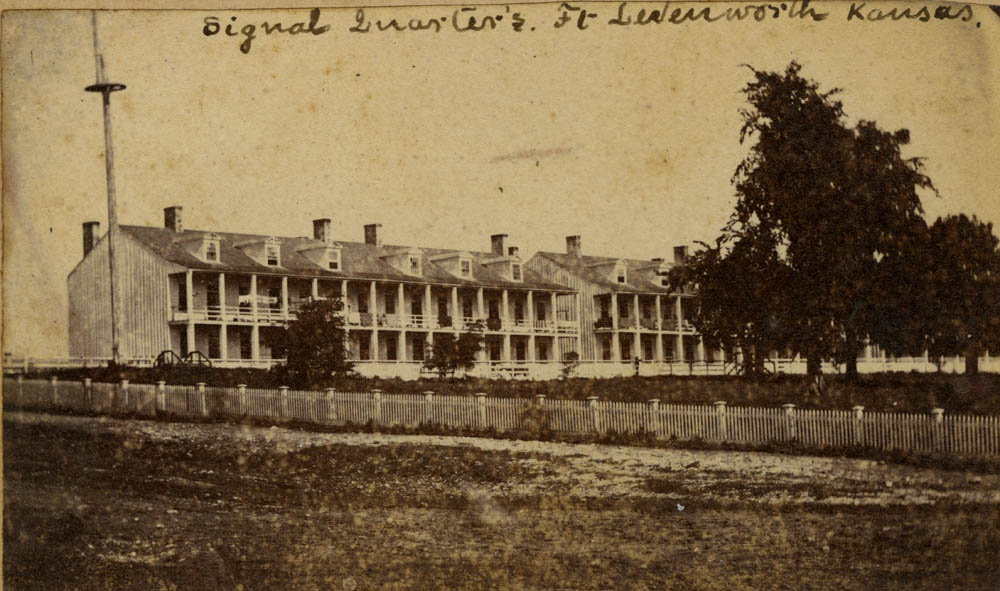
Photo source: Ozarks Civil War — Signal Corps Quarters.
The American Civil War produced few military organizations as innovative as the United States Army Signal Corps. Under the leadership of Maj. Albert J. Myer, the Corps introduced standardized visual signaling to the United States Army, employing flags by day, torches by night, and eventually field telegraph equipment to extend communications across the battlefield.
Most students of the war encounter the Signal Corps through the great eastern campaigns. Gettysburg, Petersburg, Antietam, and Chancellorsville all featured prominent signal stations overlooking the battlefield. Officers positioned on Little Round Top, Elk Mountain, or other commanding elevations watched troop movements through telescopes while relaying messages across miles of countryside. Such images have become inseparable from the Corps’ history.
The Trans-Mississippi tells a different story.
West of the Mississippi River, armies were generally smaller, roads poorer, forests denser, and distances greater. Rather than commanding immense infantry formations maneuvering across open terrain, Union commanders often led rapidly moving columns operating hundreds of miles from established bases. These conditions forced military communications to develop differently than they did in Virginia.
Consequently, the western Signal Corps remains one of the least-studied specialized organizations of the Civil War.
Unlike infantry regiments, Signal Corps detachments rarely appeared in orders of battle. They seldom occupied dramatic positions in official reports. Their successes often became invisible because successful communication simply allowed commanders to command.
If messages arrived on time, no one necessarily commented.
If observation prevented surprise, commanders recorded the resulting decision rather than the officer who supplied the information.
One of those overlooked organizations was Capt. Edwin I. Meeker’s Signal Corps detachment of the Department of Kansas.
Although numbering only about thirty men in the field, Meeker’s command accompanied Maj. Gen. Samuel R. Curtis during Price’s Missouri Expedition in the autumn of 1864. Their duties extended far beyond waving signal flags. During the campaign they served as observers, intelligence officers, couriers, headquarters aides, quartermasters, and communications specialists.
Their work placed them near the center of one of the largest and most consequential campaigns fought west of the Mississippi. Yet outside specialized Signal Corps histories, they remain almost entirely absent from the broader historical narrative.
Building the Department of Kansas Signal Corps
Congress formally recognized the Signal Corps on March 3, 1863, transforming Myer’s experimental signaling system into a permanent branch of the United States Army.
Implementation, however, was uneven.
The Army of the Potomac had already demonstrated the usefulness of organized signal detachments during the Peninsula Campaign and the fighting around Second Bull Run. Eastern armies increasingly integrated signal officers into headquarters operations, observation posts, and battlefield communications networks.
The Trans-Mississippi developed more slowly.
During 1862 and much of 1863, military communications west of the Mississippi depended primarily upon three systems:
- mounted couriers;
- the expanding United States Military Telegraph network;
- and local staff officers performing temporary communications duties.
No permanently organized Signal Corps detachment has yet been firmly identified with the Army of the Frontier. This should not be interpreted as evidence that communications were neglected. Telegraph records demonstrate that communications were central to military operations throughout the region. During the Prairie Grove campaign, for example, Brig. Gen. James G. Blunt’s request for reinforcements traveled by courier to the nearest telegraph station before entering the military telegraph network and reaching the command of Brig. Gen. Francis J. Herron. The movement of that information influenced the course of the campaign even though no organized visual Signal Corps detachment has been conclusively documented with the field army.
The Department of Kansas finally received a permanent Signal Corps organization during the summer of 1864. On June 10, 1864, Sgt. Chester P. Warriner departed the Signal Camp at Georgetown, District of Columbia, leading fifty-six enlisted signalmen west to Fort Leavenworth.
These men represented eight states:
| State | Number of men |
|---|---|
| Massachusetts | 17 |
| Rhode Island | 14 |
| Ohio | 8 |
| New York | 7 |
| Pennsylvania | 4 |
| New Hampshire | 3 |
| Connecticut | 2 |
| Maine | 1 |
Capt. Edwin I. Meeker soon assumed command of the organization.
His officer cadre included:
- Lt. Julian R. Fitch;
- Lt. Cyrus M. Roberts;
- Acting Signal Officer Josiah M. Hubbard;
- Acting Signal Officer McGinly M. Neely;
- Acting Signal Officer Ira Quinby;
- Acting Signal Officer Abraham Ellis;
- Acting Signal Officer John H. Boalt.
Including officers and enlisted men, the complete departmental organization numbered approximately sixty-four personnel.
Even by Civil War standards, it was remarkably small.
A typical Union infantry regiment might still field several hundred soldiers by late 1864. An artillery battery commonly numbered around one hundred officers and men. Meeker’s entire departmental Signal Corps was closer in size to a single understrength infantry company.
That small size was intentional.
The Signal Corps did not fight as a line organization. Its purpose was to multiply the effectiveness of commanders by improving their ability to observe the battlefield, move information, and maintain control over widely separated formations.
Throughout the summer of 1864, the detachment remained at Fort Leavenworth. Its duties centered upon signal instruction, flag drill, equipment maintenance, mounted training, and preparation for eventual field service.
No major campaign employment has been firmly identified during this period.
Everything changed when Confederate Maj. Gen. Sterling Price entered Missouri.
Into the Field
Price’s 1864 expedition was intended to restore Confederate influence in Missouri, gather recruits, threaten Federal control of the state, and possibly influence the presidential election. As Price’s army advanced northward and then turned west, Maj. Gen. Samuel R. Curtis organized the Army of the Border to defend Kansas and confront the Confederate column.
Curtis requested Signal Corps support.
Meeker selected twenty-five enlisted signalmen from his fifty-six-man organization. Together with a small group of officers, they formed a field party of approximately thirty men.
The precise strength requires some qualification. Meeker’s formally selected party appears to have included himself, four other officers, and twenty-five enlisted men, producing a total of thirty. Acting Signal Officer Josiah M. Hubbard, however, accompanied Curtis’s headquarters and continued performing signal duties during the campaign. This places at least thirty-one Signal Corps-affiliated officers and enlisted men with the army, depending upon how Hubbard was administratively counted.
The expedition departed Fort Leavenworth on October 11, 1864.
According to later Signal Corps accounts, the men received only about thirty minutes’ notice before marching. The party drew fresh horses and carried a single wagon.
Each field signal officer was assigned three mounted enlisted signalmen. These compact teams could operate independently as observation parties, establish signaling points, carry equipment, or move rapidly with headquarters. The remaining men supported transportation, reserve duties, courier work, equipment, and camp functions.
Several Signal Corps officers were immediately absorbed into Curtis’s headquarters organization.
- Julian R. Fitch served as quartermaster.
- Cyrus M. Roberts acted as an aide.
- Ira Quinby acted as an aide.
- Josiah M. Hubbard served as an assistant adjutant general while continuing to perform signal and observation duties.
This arrangement illustrates an often-overlooked aspect of Civil War signal service.
Signal officers were not merely flagmen.
Their training in observation, communications, codes, reporting, and independent field work made them valuable staff officers. When terrain or tactical circumstances prevented conventional signaling, they could still serve as observers, intelligence collectors, couriers, scouts, and aides.
Little Blue River
The detachment reached the Army of the Border during the rapidly developing operations east of Kansas City.
At the Little Blue River on October 21, Confederate pressure developed so quickly that Meeker reported there was no opportunity to establish organized signal stations.
This fact is important.
The absence of visible flag signaling did not mean the Signal Corps was absent or inactive. It meant that the speed and character of the battle prevented the use of its preferred communications method.
The men remained with Curtis’s headquarters and continued serving in staff and courier roles as the Union force withdrew toward the Big Blue.
The Big Blue River
The fighting along the Big Blue on October 22 marked the detachment’s first clearly documented operational employment.
Meeker established observation stations on opposite portions of Curtis’s line.
Hubbard was sent approximately two miles toward the extreme right, while Neely occupied a position roughly half a mile toward the extreme left. Roberts assisted in selecting observation points, while Roberts and Quinby also served as aides to Curtis.
The officers were ordered to watch Confederate movements and report approximately every thirty minutes.
Heavy timber prevented effective visual communication between the stations and Curtis’s headquarters. Instead of abandoning the operation, the Signal Corps adapted. Mounted couriers carried the reports.
Meeker copied or distributed the resulting intelligence to senior Union commanders, including James G. Blunt, Charles W. Blair, and George W. Deitzler.
The episode demonstrates that Signal Corps work could continue even when no flags were visibly exchanging messages. The essential task was not the waving of a flag; it was the acquisition and movement of useful information.
At the Big Blue, the officers functioned as battlefield observers and intelligence specialists.
Westport
The Battle of Westport on October 23 represents the best-documented action of Meeker’s detachment.
Quinby and Neely occupied an elevated position on the Harris House, overlooking portions of the battlefield near Brush Creek. From the roof, they could observe Confederate movements and the developing Union attack.
Hubbard was sent toward the front with the intention of forming a communications relay between the observation position and Curtis’s headquarters.
The proposed visual line was never fully established. The changing tactical situation and Confederate withdrawal overtook the effort. Nevertheless, Quinby and Neely continued observing the battlefield and personally reported valuable information to Curtis.
Hubbard carried or transmitted messages as the Union advance continued.
The work at Westport was therefore not a textbook demonstration of long-distance flag signaling between fixed mountaintop stations. It was a flexible combination of elevated observation, attempted visual communication, courier service, direct reporting, and staff work.
That flexibility was well suited to the western battlefield.
The dense timber around Brush Creek obstructed long lines of sight. The rapid movement of mounted forces made fixed stations difficult to maintain. Meeker’s men compensated by moving with headquarters and converting observation into actionable intelligence.
Their efforts are largely absent from Curtis’s official battle report.
This omission is itself historically significant.
Curtis recorded the movements of divisions, brigades, cavalry, and artillery, but said little about the small staff organization feeding information into his headquarters. Without specialized Signal Corps reports and the later work of Signal Corps veterans, the detachment’s contribution at Westport might have disappeared entirely.
The Pursuit of Price
Following the Union victory at Westport, Curtis’s forces pursued Price southward through Missouri and Kansas.
Meeker’s men remained with the advancing army.
On October 24, Hubbard occupied an elevated position in a church and sent information rearward before continuing with the advance. Signal Corps accounts describe him reporting by signal during the pursuit.
The party accompanied Curtis through the sequence of actions that followed:
- Marais des Cygnes;
- Mine Creek;
- Marmiton River;
- Second Newtonia;
- and the continued pursuit toward the Arkansas River.
The level of documentation varies from engagement to engagement.
Hubbard can be placed with the advance through the morning fighting on October 25, strongly associating Signal Corps personnel with the actions at Marais des Cygnes and Mine Creek. The detachment remained with Curtis during the later pursuit, although specific signal stations or individual assignments have not been identified for every battlefield.
As the campaign accelerated, conventional signaling became increasingly difficult. The army was moving rapidly, the terrain was often wooded, and headquarters shifted constantly.
The officers therefore continued serving in other capacities:
- collecting intelligence;
- observing roads and enemy movements;
- carrying dispatches;
- acting as headquarters aides;
- assisting with returns and records;
- managing transportation and logistical duties.
On November 1, fifteen enlisted signalmen under Sgt. Warriner were transferred to a headquarters quartermaster detail under Fitch. This reassignment further demonstrates the fluid use of the detachment. The men remained valuable not because they performed one narrow task, but because they were trained, mounted, mobile, and accustomed to operating close to command.
The expedition ultimately covered more than eight hundred miles over approximately thirty-nine days before the active pursuit ended near the Arkansas River.
A Tiny Detachment in a Vast Campaign
Meeker’s entire field organization represented only a minute fraction of the Army of the Border.
With roughly thirty men in the field, the detachment was smaller than many infantry companies and considerably smaller than a typical artillery battery. Yet it supported senior commanders across a campaign extending hundreds of miles.
That disparity between size and function helps explain both the historical importance and the later obscurity of the organization.
The Signal Corps did not occupy a continuous battle line. Its men were divided among headquarters, observation points, courier routes, wagons, and independent assignments. A visitor to the army might encounter only three enlisted signalmen and one officer at a time.
In an order of battle dominated by regiments and batteries, such teams were easily overlooked.
Their small size also makes Meeker’s organization particularly useful as a model for understanding how Signal Corps detachments actually functioned.
The basic operational team was not a massed formation of dozens of flagmen. It was often one officer with three mounted enlisted men, supported by additional personnel at headquarters or in reserve.
Such a team could establish an observation station, communicate with another post, carry reports, scout a position, or move with a commanding general.
Known Personnel
Six officers can presently be associated directly with the field service of the detachment during Price’s expedition:
- Capt. Edwin I. Meeker;
- Lt. Julian R. Fitch;
- Lt. Cyrus M. Roberts;
- Acting Signal Officer Josiah M. Hubbard;
- Acting Signal Officer Ira Quinby;
- Acting Signal Officer McGinly M. Neely.
Two enlisted men can presently be identified with confidence:
- Sgt. Chester P. Warriner;
- Charles M. Latham.
Warriner had originally led the fifty-six enlisted signalmen from Georgetown to Fort Leavenworth and later commanded the fifteen-man quartermaster detail created during the pursuit.
Latham was wounded during the campaign. Later biographical accounts state that he was shot in the heel while serving with the advancing Union forces. Complications from the wound reportedly contributed to his later death.
The identities of the other enlisted men selected for the field party have not yet been firmly recovered.
Their names almost certainly appear somewhere among Signal Corps personnel histories, assignment records, transportation issues, campaign returns, pension documents, or related archival materials. For now, they remain part of the larger fifty-six-man Fort Leavenworth roster but cannot be assigned individually to the campaign without further evidence.
Why the Signalmen Disappeared
One of the most striking aspects of Meeker’s service is how completely his men disappeared from conventional histories of the campaign.
This was not because their work was useless, it reflects the nature of staff service.
Battle reports were generally organized around combat commands. Infantry regiments, cavalry brigades, artillery batteries, and senior commanders occupied most of the narrative. Specialized personnel appeared only when their actions were unusually dramatic or when a failure in communications demanded explanation.
When a signal officer correctly observed an enemy movement and delivered the information to headquarters, the commanding general might record the decision that followed without identifying the source of the intelligence.
When a courier carried a report through dangerous country, the report itself survived while the courier’s name disappeared.
When a signal line worked, the resulting message entered the official record, but the men who transmitted it often did not.
The same problem affected the United States Military Telegraph Corps. Its operators and repair crews maintained the fixed electric communications network that connected headquarters, supply centers, and distant commands. Their work influenced entire campaigns, yet they were civilians under military authority and did not fit neatly into conventional unit histories.
The Signal Corps and Military Telegraph Corps were often present without being visible.
Meeker’s detachment provides a clear example. Curtis’s official report of Westport barely acknowledges its existence, yet Meeker’s own account shows his officers observing the battlefield, reporting enemy movements, and operating directly within Curtis’s headquarters.
Their absence from the broader narrative is therefore a documentation problem rather than evidence of inactivity.
The Western Character of Signal Service
The experience of Meeker’s men also challenges the popular image of Civil War signaling.
In the East, the Corps is often remembered through dramatic scenes of flags moving from mountain to mountain or between high ridges. Such operations did occur, but they represented only one aspect of signal service.
The western theater required a different form of adaptability.
Dense forests restricted visibility. Rapid cavalry movements shortened the useful life of fixed stations. Vast distances and poor roads complicated communication between headquarters and the front.
Under those conditions, the Signal Corps became more than a visual communications organization.
Its officers combined technical signaling skills with observation, reconnaissance, intelligence analysis, courier work, and ordinary staff service. Their value came from their ability to collect and transmit information under changing circumstances.
The Big Blue and Westport demonstrate this clearly.
When trees prevented direct flag communication, Meeker used couriers.
When a proposed relay line could not be completed, Quinby and Neely continued observing from the Harris House and reported personally.
When the army moved too quickly for permanent stations, officers rode with the advance and served as aides.
This was not a departure from Signal Corps work. It was the practical application of its underlying purpose.
Conclusion
For generations, the story of Civil War communications in the Trans-Mississippi has been told largely through the movements of armies and the decisions of commanding generals. Hidden behind those narratives were the small organizations that enabled commanders to receive information, issue orders, and maintain control over rapidly changing battlefields.
Capt. Edwin I. Meeker’s Department of Kansas Signal Corps detachment was one of those organizations.
When the detachment entered the field in October 1864, it numbered only about thirty officers and enlisted men—a force so small that an infantry regiment might outnumber it by more than ten to one. Yet during Price’s Missouri Expedition, these men became an integral part of Maj. Gen. Samuel R. Curtis’s headquarters.
They established observation posts, gathered intelligence, relayed reports, carried dispatches, performed staff duties, managed logistics, and employed visual signaling whenever terrain permitted.
Far from being limited to waving signal flags, they adapted continuously to the demands of a fast-moving western campaign.
The western theater required a different kind of Signal Corps than the one familiar from the great eastern battlefields. Dense forests, broken terrain, and rapidly maneuvering cavalry columns frequently rendered long-range visual signaling impractical. Rather than diminishing their usefulness, these conditions expanded their responsibilities.
Meeker’s officers became observers, scouts, aides, couriers, and intelligence officers whose technical training made them uniquely valuable to headquarters.
Their obscurity in the historical record should not be mistaken for insignificance.
Curtis’s official reports mention little of their work, and most general histories of Price’s Missouri Expedition omit them entirely. Yet Signal Corps records, veterans’ accounts, and departmental histories reveal that these officers were present near the center of operations during some of the campaign’s most critical moments.
Their experience illustrates a broader truth about Civil War history: specialized staff organizations often exercised influence far beyond what their numbers—or the surviving battle narratives—might suggest.
Significant questions remain, particularly the identities of most of the enlisted signalmen selected for field service. Those answers may still lie within personnel records, correspondence, campaign reports, pension files, and other archival collections that have received far less attention than the records of infantry and cavalry organizations.
That gap should be viewed not as a weakness of the history, but as an invitation for further research.
The story of Meeker’s detachment demonstrates that the history of the Civil War is not yet complete. Even after more than 160 years, careful examination of overlooked records can restore forgotten organizations to their proper place in the historical narrative.
The men of the Department of Kansas Signal Corps did not win battles through massed volleys or dramatic cavalry charges. They contributed in quieter ways—by ensuring that commanders saw farther, knew more, and acted sooner than they otherwise could have.
Their service was measured not in captured flags or enemy casualties, but in information: gathered, transmitted, interpreted, and delivered when it mattered most.
Though small in number and long overshadowed by the armies they served, the forgotten signalmen of the West deserve to stand once again among the soldiers whose service shaped the outcome of the Civil War in the Trans-Mississippi.
Sources and Further Reading
The following sources form the principal documentary basis for this article. Brown’s history and surviving Signal Corps campaign material provide the core account of Meeker’s detachment, while the Official Records, archival guides, diaries, and modern battlefield studies supply broader organizational and campaign context.
Primary and Contemporary Sources
-
J. Willard Brown, The Signal Corps, U.S.A. in the War of the Rebellion (1896).
The principal published source for the organization, personnel, movements, and operations of the Department of Kansas Signal Corps. Brown was himself a Civil War signalman and compiled his history from official records, reports, correspondence, and information supplied by veterans.
Read the complete volume at Internet Archive -
“Battle of Westport Letter,” United States Signal Corps, Department of Kansas.
A surviving partial account of the travels and operations of the Department of Kansas Signal Corps during Price’s expedition, beginning October 11, 1864.
View the document at the Civil War Virtual Museum -
The Diary of Capt. Cyrus Marion Roberts.
Roberts served as one of Meeker’s signal officers and as an aide to Maj. Gen. Samuel R. Curtis. The surviving diary material includes the period surrounding Price’s Missouri Expedition and provides valuable personal and operational context.
Read the Roberts diary collection -
United States War Department, The War of the Rebellion: A Compilation of the Official Records of the Union and Confederate Armies, Series I, Volume XLI.
This volume contains reports and correspondence concerning operations in the Trans-Mississippi from July through December 1864, including Price’s Missouri Expedition and the battles around Kansas City and Westport.
Access the Official Records through the National Archives -
William R. Plum, The Military Telegraph During the Civil War in the United States (1882).
Plum’s history provides essential context for the separate United States Military Telegraph organization and the development of wartime communications in Missouri, Kansas, Arkansas, and the wider western theater.
Read Volume II at Internet Archive
Archival Collections
-
National Archives, Record Group 111: Records of the Office of the Chief Signal Officer.
Record Group 111 contains Civil War-era reports of operations, inspection reports, correspondence, personnel histories, assignment records, equipment records, messages, and organizational material. These holdings are the most promising source for identifying the enlisted men who accompanied Meeker into the field. Many relevant records have not yet been digitized.
View the National Archives guide to Record Group 111 -
Signal Corps Association, 1860–1865.
This collection provides digitized rosters, diaries, manuals, biographical material, and transcriptions concerning Union Signal Corps personnel and operations.
Explore the Signal Corps Association research collection
Modern Studies and Campaign Context
-
Ronald S. Coddington, “On Quinby’s Watch: A Colorado Lieutenant and Acting Signal Officer Makes His Mark at ‘The Gettysburg of the West.’”
This detailed modern study of Acting Signal Officer Ira Quinby draws upon Meeker’s report and related records to reconstruct Signal Corps observation and intelligence work at the Big Blue and Westport.
Read the article in Military Images -
Charles D. Collins Jr., Battlefield Atlas of Price’s Missouri Expedition of 1864.
Published by the U.S. Army’s Combat Studies Institute, this atlas provides maps, troop movements, campaign chronology, and operational context for the battles and pursuit in which Meeker’s men served.
Download the atlas from Army University Press -
Rebecca Robbins Raines, Getting the Message Through: A Branch History of the U.S. Army Signal Corps.
This official U.S. Army history provides broader context concerning the establishment, doctrine, equipment, and wartime development of the Signal Corps.
Read the book through the U.S. Army Center of Military History